Reducing environmental impact remains one of Nornickel’s strategic priorities. The Company strictly complies with environmental legislation, identifies and manages environmental risks, regularly trains employees, improves environmental controls, streamlines production processes, and takes biodiversity conservation and restoration measures.
In 2025, the Company updated its Environmental and Climate Change Strategy, extending its planning horizon to 2035 and introducing new initiatives, including the construction and modernisation of wastewater treatment facilities, biodiversity restoration efforts, replacement of legacy dust collection equipment, and the commissioning of mobile waste treatment units. The updated strategy reaffirms Nornickel’s commitment to reducing greenhouse gas emissions. Excluding the climate change track, the voluntary part of the Strategy focuses on developing circular economy solutions and the phased implementation of measures to increase the percentage of mineral and non‑mineral waste that is recycled, as well as ensuring closer alignment with sustainability standards.
To date, 277 measures are being implemented or are planned under the Strategy.
In place since 2005, the Company’s environmental management system is part of the integrated quality and environmental management system. This ensures coordination between all environmental matters and other areas, enhancing the Company’s overall performance on environmental safety.
Environmental audits
The Company confirms the compliance of its environmental management system with ISO 14001:2015 by engaging Bureau Veritas Certification Rus (BVC) to conduct surveillance audits annually and recertification audits every three years. Bureau Veritas Certification Rus operates in Russia under the accreditation of the Egyptian EGAC, which is a full signatory and participant of the IAF MLA.Multilateral Recognition Arrangement of the International Accreditation Forum.
In 2023, based on the results of a recertification audit, the Company received a certificate of conformity valid until 12 January 2027. The second surveillance audit of the seventh certification period conducted in 2025 established full conformity with ISO 14001, and the certificate was extended for another year.
At the end of 2025, 52% of Group assetsBy average headcount. were certified to the ISO 14001 environmental standard.
ISO 14001:2015 certificate
Certified assets
Status
Head Office and branches
Norilsk site
Kola site
Certification body: Bureau Veritas Certification Rus
In 2025, a surveillance audit was conducted
International site
Certification body: Bureau Veritas Certification Rus
The international site maintains certification for conformity with ISO 14001:2015
Trans‑Baikal Division
Certification body: IRCLASS IRQS (India)
The asset’s environmental management system was certified in 2023
In 2025, a surveillance audit was conducted
Air
The Company’s principal environmental impacts include significant emissions of sulphur dioxide during the smelting of sulphide concentrates.
Sulphur Project
As part of the Clean Air federal project under the Ecological Well‑Being national project, Nadezhda Metallurgical Plant is implementing the ambitious Sulphur Project, an initiative unprecedented in its scale and designed to deliver a significant reduction in sulphur dioxide emissions.
Nornickel’s development strategy is to transform the Company into an environmentally safe business, including by implementing the Sulphur Project at the Kola and Norilsk production sites.
At the Kola site, the Sulphur Project helped reduce sulphur dioxide emissions by over 90% compared to the 2015 base year. The slight increase in sulphur dioxide emissions in 2025 is due to increased processing volumes.
At the Norilsk site, the Sulphur Project is implemented at Nadezhda Metallurgical Plant and includes technological upgrades to recover sulphur dioxide from off‑gases of flash smelting furnaces by converting them into sulphuric acid and then neutralising it with limestone. The resulting gypsum pulp from the neutralisation process is stored in a dedicated gypsum storage facility.
In October 2023, the first process line was launched, with 7.5 kt of sulphur dioxide recovered before the end of the year. In September 2024, the Company launched comprehensive testing of the second process line, boosting sulphur dioxide recovery from gases to approximately 390 kt. In 2025, implementation of the Sulphur Project continued, with a range of procurement and construction activities carried out, various items of process equipment installed, and commissioning works undertaken. At the sulphuric acid production section, construction work was carried out on the third process line. Its subsequent launch will enable continuous sulphuric acid production across the full circuit, ensuring the project’s sulphur dioxide recovery targets are met while also allowing for timely equipment maintenance. In 2025, the Company recovered 489 kt of sulphur dioxide.
In 2025, the Group’s pollutant emissions totalled 1.2 mln t, down 8% y‑o‑y.
Sulphur dioxide emissions at the Norilsk site, kt
Sulphur dioxide emissions at the Kola site, kt
Air pollutant emissions across the Group, ktFigures may not sum up due to rounding.
Indicators
2021
2022
2023
2024
2025
Sulphur dioxide (SO2)
1,601
1,778
1,671
1,269
1,160
Nitrogen oxide (NOX)
11
10
6
6
6
Particulate matter
9
11
11
11
12
Other pollutants
25
21
20
21
25
Total
1,647
1,819
1,708
1,307
1,202
Environmental monitoring programme
The programme targets two areas: mandatory industrial emissions control at production sites and voluntary urban air quality monitoring.
In compliance with legal requirements, the Company has introduced automated emissions control systems at its operations, with data transmitted every 20 minutes on a continuous basis. In 2026, including through these systems, the Company plans to track industrial emissions of key pollutants: sulphur dioxide, suspended solids (dust), and carbon monoxide.
In late 2024, Nornickel launched the first integrated real‑time air quality monitoring system in urban communitiesNorilsk, Kayerkan District, and Talnakh. in the Arctic Circle. Today, the monitoring data are used to calculate an air quality index, which is posted on the Норильск.рфwebsite and uses colour indication: green – no pollution, yellow – moderate pollution, red – high pollution.
In mid‑2025, Nornickel handed over to the Monchegorsk Administration a similar air quality monitoring system for residential areas. Data from the system can be viewed on the Mончегорск.рфwebsite.
The Company is actively developing the AXIOMA predictive system as an alternative to conventional automated emissions control solutions. During 2025, the system was tested at the Norilsk and Kola sites.
Environmental monitoring stations
Operations
Number of stations
Norilsk Industrial District
16
Monchegorsk
11
Nikel settlement, Murmansk Region
1
Zapolyarny, Murmansk Region
1
Water
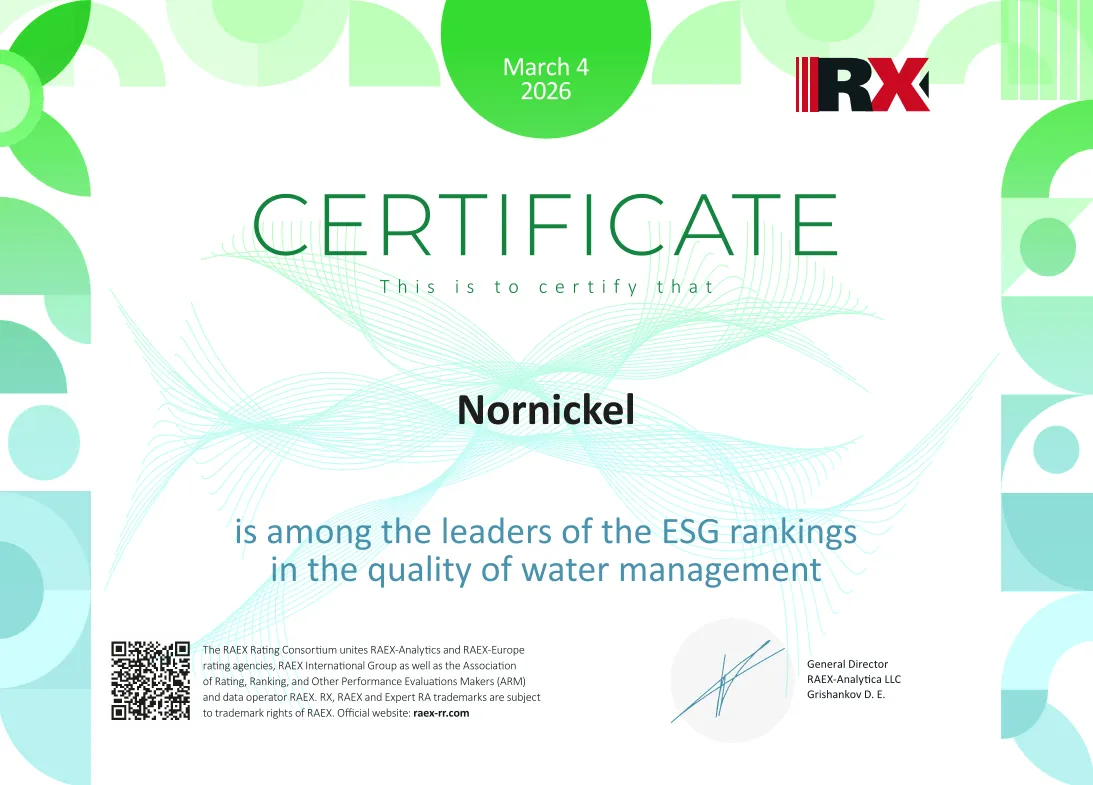
RAEX ranked Nornickel among the leaders in water stewardship for the second year in a row.
Company enterprises are located in regions with sufficient water resources. In 2025, no water stress was reported, as both enterprises and local populations were supplied with adequate water volumes.
Nornickel’s operations are associated with the following water‑related risks:
Pollution of water bodies resulting from tailings or petroleum product spills
Pollution of water bodies due to poor performance of wastewater treatment facilities
Depletion of water bodies caused by withdrawals exceeding permitted limits
The Company is committed to the responsible and sustainable use of water resources and the prevention of water body pollution. To this end, the Company regularly monitors groundwater at production sites and is designing systems to collect and treat mine‑impacted water. All facilities using water monitor water bodies and water protection areas. Nornickel does not withdraw water from protected natural sites and strictly complies with water withdrawal limits.
Nornickel’s key production facilities operate closed‑loop water systems. Water is mostly withdrawn from surface and underground sources, but also includes third‑party wastewater and natural inflow. In 2025, total water withdrawal increased by 26 Mcm y‑o‑y. Natural water inflow accounted for approximately 16% of total water withdrawal in 2025.
80% of all water used by the Company for production activities was recycled and reused, including produced and mine water used to neutralise sulphuric acid under the Sulphur Project.
Water consumption and wastewater discharge in 2025
Wastewater discharge to water bodies primarily stays within permitted limits and has no material impact on biodiversity. In 2025, wastewater discharge increased by 18% due to the discharge of water (clean to standards) used for cooling at CHP plants.
Nornickel takes all possible measures to ensure that pollutant concentrations in wastewater comply with regulatory requirements. All domestic sewage discharges are routed through biological or physico‑chemical treatment facilities. In 2025, the mass of pollutant discharges decreased by 4% to 86 kt.
Nornickel consistently invests in improving the efficiency of existing water treatment systems and building new ones, and it regularly assesses its impact on water resources. The relevant measures include:
wastewater inventory;
assessment of wastewater quality at accredited laboratories at legally mandated intervals;
monitoring of wastewater discharge volumes and quality at discharge sites;
observation of surface water bodies at control points upstream and downstream of discharge sites;
monitoring of wastewater treatment processes at treatment facilities and implementation of organisational and technical measures to improve treatment effectiveness.
Impacts from water transport
The Company takes steps to reduce fuel consumption by its water transport and to prevent contamination of the Dudinka and Yenisei Rivers.
Waste
Of the waste generated in the Company’s own activities, 99% is classified as non‑hazardous. This includes rock and overburden, tailings, metallurgical slags, and ferrous cake. Ore extraction waste is placed in waste rock dumps and used for backfilling mined‑out underground stopes and open pits, as road fill, or for reinforcing tailings dams. Of the total waste generated, gangue accounts for 80%, tailings for 17%.
Key methods for reintegrating waste into own production include recycling in smelting furnaces, oil recovery, use as flux, incorporation into furnace charge materials, and application in construction.
Waste generation in 2025 declined due to revisions to the mining plan.
Waste generation by hazard class, kt
Waste management, kt
Waste disposal
The Company currently operates six active tailings storage facilities: four at the Norilsk site, one at the Kola site, and one in the Trans‑Baikal Division. All of them are situated at a considerable distance from production sites and human settlements.
Nornickel recognises that tailings storage facilities are high‑risk assets with the potential for significant environmental impacts and consequences for the quality of life of local communities. The Company has developed a Tailings Management Policy and conducts regular monitoring of the condition of tailings dams, discharge sites, and adjacent areas.
As part of the Sulphur Project, a gypsum storage facility was also constructed and is currently in the pre‑commissioning stage. The facility is designed for the safe storage of gypsum pulp.
Waste recovery in 2025 declined compared with 2024 due to changes in subsoil legislation, under which certain overburden and host rocks, as well as tailings, have been excluded from the definition of “production and consumption waste” and are therefore no longer included in waste accounting records. Of the total waste generated recycled or reused waste makes up 10%.
Land and biodiversity
Land
The Company’s priority in land conservation is to reduce and, where possible, prevent negative impacts associated with its operations.
Nornickel regularly participates in landscaping and greening initiatives in the regions where it operates. The Company has developed an action plan for the rehabilitation of disturbed areas, which includes clean‑up and improvement of municipal areas adjacent to motorways, protection of water bodies and water protection areas, and the enhancement of local holiday camps. These initiatives are implemented in cooperation with local authorities and employee volunteers from Nornickel.
Land disturbed and reclamation, ha
Indicators
2022
2023
2024
2025
Land disturbed at the beginning of the reporting period
16,694
16,906
17,225
16,750
Land disturbed during the reporting period
317
297
199
439
Reclamation
75
15
71
0
Land disturbed at the end of the reporting period
16,936
17,188
17,353
17,189
Land rehabilitated, ha
Indicators
2022
2023
2024
2025
Land rehabilitated, including:
575
339
236
286
Revegetation
2
7
9
4
Clean‑up
178
80
73
54
Reforestation
285
112
87
212
Reclamation (from strategy)
110
140
66
16
Biodiversity conservation
For many years, Nornickel has supported initiatives aimed at conserving and restoring biodiversity in the regions where it operates. Since 2022, Nornickel has partnered with scientists from the Russian Academy of Sciences (RAS) to conduct biodiversity assessments. Over the course of several expeditions, comprehensive ecosystem studies were carried out in the Company’s regions of operation, namely the Murmansk Region and the Krasnoyarsk and Trans‑Baikal Territories.
These biodiversity surveys became the most extensive ecosystem study since the Soviet era. As part of its collaboration with the RAS Siberian Branch Institute of Systematics and Ecology of Animals, the Company worked with scientists to develop the Integrated Ecosystem Health Indicator (IEHI), a methodology for assessing ecosystem health based on a comparison of biodiversity at sites affected by economic activity and at unaffected reference sites. The methodology is planned to be piloted at test sites and, from 2027, made freely available for public consultation and potential wider rollout.
The latest research reports, more detailed information on the IEHI framework, and biodiversity conservation initiatives and best practices are available on the dedicated Preserving Ecosystems website, as well as on the Company website under the Biodiversity section.
In 2025, Russia launched the Ecological Well‑Being national project, which includes a Biodiversity Conservation and Ecotourism Development track. Based on this project, 24 national biodiversity conservation objectives have been defined and will be incorporated into a new strategy for the conservation and sustainable use of biodiversity. Guided by this national framework, Nornickel developed a draft Corporate Biodiversity Conservation Programme to 2035, which was unveiled in December 2025. The country’s first 10‑year corporate biodiversity conservation programme consolidates ongoing and planned projects in line with Nornickel’s current priorities and values.
Fish stocking programme
Since 2023, under an agreement between the Company, the Federal Agency for Fishery, and the Russian Federal Research Institute of Fisheries and Oceanography (VNIRO), annual fisheries studies have been carried out across the lake‑river system that comprises Lake Pyasino and the Pyasina River, as well as the Ambarnaya, Norilskaya, Daldykan, Agapa, Dudypta, Tareya, Pura, and Ozernaya Rivers. The purpose of this effort is to develop scientific recommendations for restoring aquatic ecosystems and commercial fish stocks. During the 2025 field season, quantitative surveys of whitefish fry were carried out for the first time along the entire length of the Pyasina River and across its main tributaries. Haematological studies were also launched on samples from whitefish, nelma, broad whitefish, and muksun to assess their physiological condition and health, and whole‑genome analysis was conducted on samples of whitefish, muksun, broad whitefish, nelma, and Siberian sturgeon from the Pyasina River, with the results compared against existing genomic data for these species from other Siberian river basins.
The Company is also contributing to efforts to breed and release juveniles of valuable fish species into water bodies. Nornickel works with Russian aquaculture producers, including those based in the Krasnoyarsk Territory. Under the agreement, the Company plans to release 540 million juveniles of valuable fish species into the Yenisei and water bodies of the Norilo‑Pyasina lake‑river system between 2023 and 2052. Since 2023, 9 million Siberian sturgeon fingerlings have already been released into the Yenisei, including 3 million in 2025.
In 2025, the Trans‑Baikal Division released peled juveniles into Lakes Shaksha and Ivan. Over the years, the Trans‑Baikal Division has released more than 2 million juveniles of valuable fish species into water bodies across the Trans‑Baikal Territory, helping to replenish fish stocks and maintain their populations.
Since 2022, the Kola site in cooperation with the Institute of Biology of the Karelian Research Centre (RAS) has been successfully implementing a project to stock water bodies near Monchegorsk using a technology unique in Russia. The Kola site’s environmental team raises juveniles of valuable fish species in their natural habitat, placing whitefish and brown trout eggs in special hatchery nests installed in lakes and rivers. Stocking helps to restore fish populations in water bodies of the Kola Peninsula, and, as a result of this technology developed by scientists, juvenile survival rates have reached 90% to 95%.
Cooperation with nature reserves
Nornickel supports nature reserves in the regions where it operates and does not conduct operations within or near protected areas:
In the Murmansk Region, the Pasvik, Lapland, and Kandalaksha Nature Reserves are located 7 to 90 km away from the Kola site’s production facilities.
In the Krasnoyarsk Territory, the buffer zone of the Putoransky Nature Reserve lies 80 to 100 km from Nornickel’s production sites.
In the Trans‑Baikal Territory, the Daursky State Nature Biosphere Reserve is located 250 km from the Company’s production facilities. The Uryumkansky and Borzinsky State Wildlife Reserves, both of regional significance, are located to the north‑east and south, respectively, of the Trans‑Baikal Division’s operational sites.
In the Krasnoyarsk Territory, the Company works closely with the Joint Directorate of Taimyr Nature Reserves on biodiversity monitoring and conservation, the development of nature reserves, support for research, and environmental education. Priority areas include monitoring and implementing a range of measures to conserve endangered species of flora and fauna. Since 2022, the Company has supported activities under the programme to study the Putorana snow sheep and develop a conservation strategy for this subspecies. Between 2023 and 2025, aerial surveys of snow sheep were carried out across the entire range, including the remote eastern part of the Putorana Plateau, which covers more than 17 thousand sq km. Further work under the snow sheep monitoring and conservation project is planned for 2026. At the Krasnoyarsk Pillars National Park, the concept for the flagship Development of the Citizen Science Volunteering Centre project is being designed jointly.
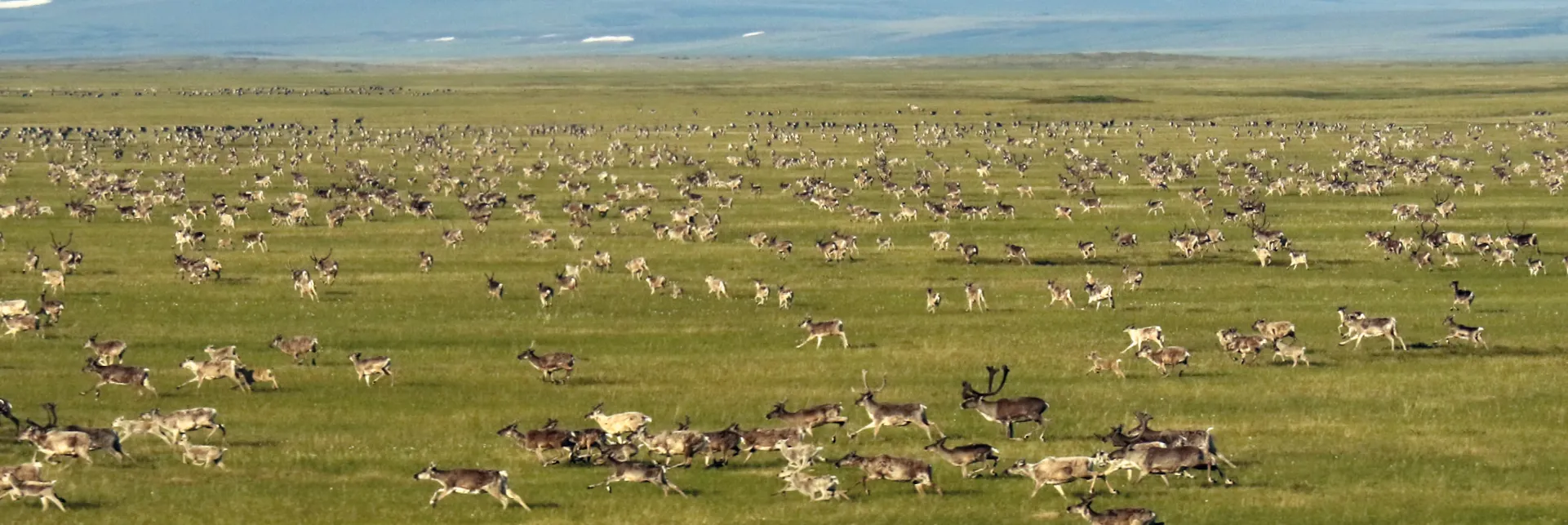
In the Murmansk Region, Nornickel has worked with the Pasvik and Lapland Nature Reserves for many years, and, since 2024, the Kandalaksha Nature Reserve has also joined this collaborative programme. To raise awareness about the preservation of the wild reindeer population, Nornickel is supporting the Let’s Save Reindeer Together project at the Lapland Nature Reserve: eco‑trails were created in the reserve, guest houses and a visitor centre were built, and two books were published – one about the founders of the reserve, and a children’s book titled Secrets of the Lapland Nature Reserve.
Similar work is also under way in the Pechengsky District, where, with the Company’s support, the Pasvik Nature Reserve is implementing a unique project to establish a Freshwater Pearl Mussel Reintroduction Centre. Plans for the species population restoration across water bodies extend beyond the district to other municipalities in the Murmansk Region.
In the Trans‑Baikal Territory, in 2025, GRK Bystrinskoye partnered with scientists to run an environmental monitoring programme in the Borzinsky State Wildlife Reserve, within the area indirectly affected by the Bystrinskoye project, using the IEHI assessment methodology.
In December 2025, the Nature and People Foundation analysed the biodiversity conservation efforts of Russia’s largest mining companies over 2023–2025 and compiled a ranking. Nornickel ranked second.
Climate
Our approach
Nornickel recognises the importance of climate change and is taking measures to better adapt its infrastructure while also working to reduce greenhouse gas emissions.
The Company continues to integrate climate risk management into its business processes in line with the TCFD recommendations and seeks to align its disclosures with IFRS S2 Climate‑related Disclosures.
To assess climate‑related risks and opportunities, the Company has adopted three corporate global scenarios for global economy and climate change until 2060 through collaboration with the Institute for Economic Forecasting of the Russian Academy of Sciences (IEF RAS).
These scenarios are aligned with climate change pathways described in IPCC’s public scenarios SSP1‑2.6, SSP2‑4.5, and SSP5‑8.5, respectively.
The Company has chosen the Sustainable Palladium as its baseline scenario, according to which traditional industries are expected to remain centre stage along with the growing green economy. In particular, internal combustion engine vehicles are expected to retain a large market share, and long‑term demand for palladium will continue to be driven by both hybrid vehicles and potential new applications. The other two scenarios are used by the Company to stress‑test climate‑related risks.
For more details on climate-related risks and opportunities, please see the Risk Management System section of this Report.
Greenhouse gases
Since 2020, the Company has been calculating its direct and indirect greenhouse gas emissions (Scope 1 + 2), including the emissions allowance for the Sulphur Project. The upcoming reconfiguration of Copper Plant is expected to reduce the Company’s pollutant emissions. Greenhouse gas emissions have been verified by independent auditors TÜV AUSTRIA and Kept.
In 2025, direct and indirect greenhouse gas emissions from operations (Scope 1 + 2) amounted to 7.5 mln t of CO2equivalent,Scope 2 emissions were calculated using the location‑based method. Gross GHG emissions (Scope 1 + 2) also include the emissions allowance for Nadezhda Metallurgical Plant’s Sulphur Project and exclude emissions from heat and electricity supplies to household consumers. and 0.2 mln t of CO2 equivalent was directly removed through tailings carbonation.
GHG emissions, Scope 1 + 2, mlnt of CO2 equivalentGHG emissions were calculated as per the GHG Protocol Guidelines. Estimates of greenhouse gas emissions for the Group included the following greenhouse gases: direct emissions of carbon dioxide (CO2), nitrogen oxide (N2O), and methane (CH4), mostly from gas transportation, including the Nadezhda Metallurgical Plant under the Sulphur Project, and heat and electricity supplies to household consumers.
Across the Nornickel Group overall, a downward trend in GHG emissions has been observed over a four‑year horizon. In 2025, the Company kept its emissions at the previous year’s level by balancing higher production performance, including the gradual ramp‑up of the Sulphur Project to design capacity, with energy efficiency measures.
In 2025, the Company kept its emissions at the previous year’s level by balancing higher production performance, including the gradual ramp‑up of the Sulphur Project to design capacity, with energy efficiency measures. The decrease in GHG removals in 2025 was driven by changes in the mineral and chemical composition of the ores sent to tailings storage facilities, as identified through analysis of tailings samples.
Due to their chemical composition and a number of other technological factors, materials in Nornickel’s tailings storage facilities are capable of naturally reacting with carbon gases in the atmosphere. This results in carbon mineralisation in mine tailings and, consequently, carbon removal from ambient air. The volume of removals depends primarily on the amounts and composition of materials deposited in the Group’s tailings storage facilities during the reporting period. The Company has certified its methodology for calculating direct GHG removals through carbon mineralisation in mine tailings, unique in Russia, to GOST R ISO 14064‑1‑2021 Greenhouse gases. Part 1. Specification with guidance at the organisation level for quantification and reporting of greenhouse gas emissions and removals. Data on actual removals for 2021–2025 have been verified by TÜV AUSTRIA and Kept.
Nornickel also plans to explore engineered carbon mineralisation, which has significant potential for greenhouse gas removal.
Nornickel’s key production facilities are located in the Norilsk Industrial District, in the Arctic Circle, and operate in sub‑zero temperatures for about eight months of the year. The district is isolated from the federal energy infrastructure, so Nornickel generates electricity and heat locally at its own generating facilities (100% owned by the Group). As a result, the bulk of GHG emissions comes from the Company’s energy assets. As Nornickel is the only producer of electricity and heat in the Norilsk Industrial District, the Company also fully meets the demand for energy and heat from social infrastructure facilities and the local population. The share of GHG emissions generated by infrastructure facilities and households in Nornickel’s regions of operation is on average 12% of total Scope 1 + 2 GHG emissions.
GHG emissions from production operations, Scope 1 + 2, mlnt of CO2 equivalent
Scope 3
The Company annually quantifies its other indirect (Scope 3) GHG emissions,Emissions are quantified in line with the GHG Protocol guidance, recommendations of the International Council on Mining and Metals (ICMM) and industry associations (including the Nickel Institute), and the IPCC Guidelines for National Greenhouse Gas Inventories. which originate outside the Group and are beyond the Group’s control or influence. The Company distinguishes between upstream and downstream Scope 3 emissions.
The bulk of upstream Scope 3 emissions is related to the purchase of raw and other materials from suppliers as well as energy and fuel consumption (to the extent not included in Scope 1 + 2).
Downstream emissions are associated with the transportation of the Company’s products from production assets to consumers and subsequent processing into finished products. The 2025 downstream emissions quantification covered nickel, copper, palladium, platinum, copper and nickel intermediates, and iron ore concentrate sold outside the Group. Emission volumes are driven by changes in sales volumes and the mix of Group’s product and customer portfolio. Downstream emissions in 2025 amounted to 4.3 mln t of CO2 equivalent. The main drivers of the year‑on‑year change were lower sales of semi‑products and updates to emission factors for logistics, including based on data published by the Global Logistics Emissions Council.
GHG emissions, Scope 3, mlnt of CO2 equivalent
Emissions by category
2021
2022
2023
2024
2025
Scope 3 (other indirect GHG emissions)
5.4
5.3
6.4
6.7
5.5
Upstream, including:
1.4
1.4
1.3
1.2
1.2
purchased goods and services
0.8
0.9
0.8
0.7
0.7
capital investments
0.1
0.1
0.1
0.1
0.1
energy and fuel
0.4
0.3
0.3
0.3
0.3
other
0.1
0.1
0.1
0.1
0.1
Downstream, including:
4.0
3.9
5.1
5.5
4.3
processing of sold products
3.8
3.7
4.9
5.3
4.2
transportation of sold products
0.2
0.2
0.2
0.2
0.1
Renewables and energy efficiency
Powered by both external and own generation facilities, Nornickel’s production assets are sources of direct and indirect greenhouse gas emissions (Scope 1 + 2).
The Company’s own energy assets are located in the Norilsk Industrial District and use low‑carbon sources for energy generation, such as natural gas and renewable hydropower. Diesel fuel, fuel oil, petrol, and jet fuel are used by Nornickel’s transport assets. Use of coal by energy assets is minimised to only small amounts in certain production processes.
The Kola site and Trans‑Baikal Division source heat from their own boiler plants and purchase electricity in the wholesale electricity and capacity market (WECM).
Share of renewable electricity consumption
Due to harsh climates, not all renewables are available in the Arctic Circle
Solar power
~8 months a year – air temperatures below freezing point
~100 days – duration of polar nights and twilights
~70 days per year – sunny days
Geothermal energy
Permafrost: 300 to 500 m deep
In 2025, the Company invested more than
USD
429million
in upgrading its energy infrastructure
The Company’s key renewable energy source is hydropower generated by the Group’s Ust‑Khantayskaya and Kureyskaya HPPs. In 2025, the share of renewables in total electricity consumption stood at 56% for the Group and 57% for the Norilsk Industrial District. Renewable energy accounted for 11% of the Group’s total energy consumption.
The use of other renewables, such as solar and geothermal energy, within the Arctic Circle is constrained by the harsh climates conditions and polar night in the regions where Nornickel’s core operating assets are located.
Nornickel attaches great importance to improving the energy efficiency of its existing and future production sites. In 2025, the Company invested more than USD 429 million in upgrading its energy infrastructure. The investments cover multiple projects related to equipment replacement at thermal and hydropower plants and upgrades to fuel tank storage facilities, power grids, and gas pipelines.
Permafrost monitoring
The geotechnical and background monitoring system developed by Nornickel for permafrost and the facilities built on it enables assessments of the impact permafrost degradation has on the stability of engineering structures in regions of operation while managing related risks.
Rapid climate change in the Arctic drives global‑scale challenges and poses a significant threat to the security of polar infrastructure.
In recent years, Nornickel focused on building a science‑based, practical framework for asset operation management. Deep monitoring wells were drilled in populated areas of the Norilsk Industrial District to study the permafrost soil temperature range and assess the impact of global climate change.